



Why IRDAI's proposed commission rules could distort insurance market competition
November 6, 2026
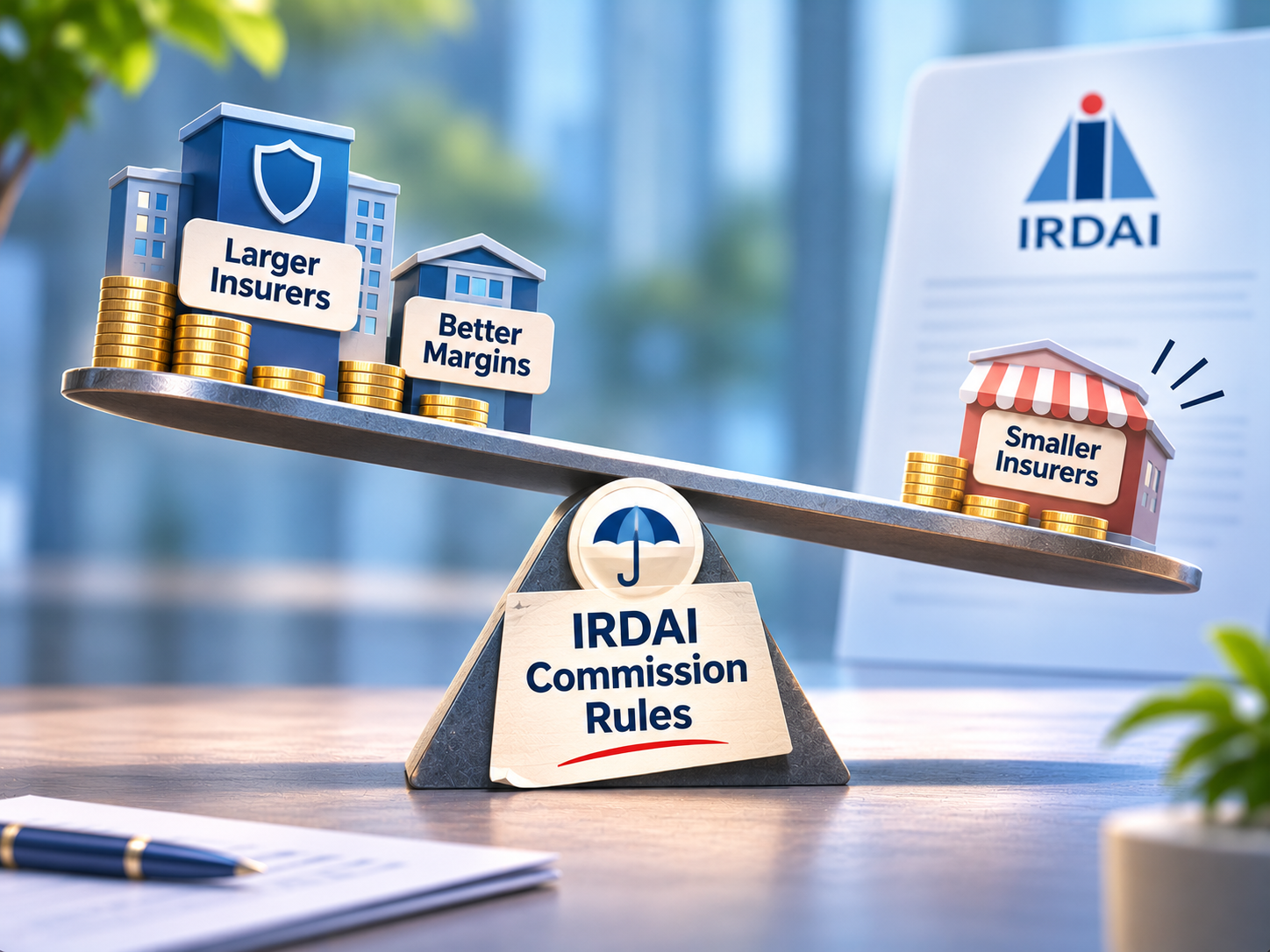
IRDAI’s consultation paper issued in September 2026 seeks to speed up insurance-sector growth, improve policyholder protection, simplify doing business for insurers and intermediaries, and increase regulatory transparency.
A key stated objective is to strengthen competition, consistent with the Competition Act, 2002 and aligned with the Draft National Competition Policy, 2011, which emphasizes a level playing field and avoiding unnecessary market restrictions.
Same policies, different rules for open and closed distributors
The proposals aim to replace the current structure of multiple types of distribution firms and individual sellers with three channels: Insurance Distribution Entities (IDEs), Insurance Distribution Persons (IDPs), and Market Infrastructure Institutions (MIIs). IDEs can operate either as open architecture (selling for multiple insurers) or closed architecture (selling for a single insurer). Insurer-linked IDPs would be allowed to sell for only one insurer in each category.
It is suggested that easier entry norms and permission for distributors to sell non-insurance products would broaden the market, and that the principle of “same activity, same regulation” would ensure fair treatment.
However, some elements appear inconsistent with the stated goals and with “competition on merits.” For instance, open-architecture distributors such as brokers can offer products from competing insurers without exclusivity constraints, and can quickly compare premiums and claim ratios to help customers make better-informed choices.
By contrast, closed-architecture distributors like an insurer’s own agents can sell only that insurer’s products in each category. Even though both channels sell similar policies to customers, the paper proposes different treatment that could be discriminatory.
Commission caps that depend on who sells, not what is sold
Under the proposals, brokers and web aggregators operating in open architecture would face lower commission caps than insurer agents across most products. In retail health insurance, a broker could earn up to 15% in year one and 5% on renewals, while an agent could earn up to 20% initially and 10% on renewals. IRDAI’s concern is that open-architecture distributors might encourage customers to switch insurers based on higher payouts.
At the same time, competition needs to be viewed across both upstream and downstream markets. Because brokers represent multiple insurers, they can provide immediate comparisons of pricing and claims experience, supporting informed customer decisions. Agents can shift business only within their own insurer. Reducing switching frictions can intensify rivalry, pushing insurers and their agents to improve pricing and service.
If an insurer is confident its agent cannot move business elsewhere, competitive pressure may weaken and lead to complacency. IRDAI’s own data shows agents account for about 30% and brokers about 33% of general insurance premium, indicating strong competition between the two. Differentiated compensation could therefore create an uneven playing field and dampen competition.
The proposed caps also differ based on legal structure. A motor dealer incorporated as a company would need to register as an IDE and could earn up to 5% on own-damage cover for a new vehicle. A sole-proprietor dealer could instead become an associate of one insurer and earn up to 10% for the same cover. This means identical work could attract double the commission purely due to business form, encouraging dealers to align with a single insurer, limiting choice at the point of sale and conflicting with the “same activity, same regulation” principle.
Why neutral platforms need to be neutral for distributors too
For health policy renewals, the proposal allows brokers up to 5% and agents up to 10%. Since renewal servicing is broadly similar, the lower broker cap could discourage participation without a clear rationale and could have wider anti-competitive effects.
IRDAI also proposes that MIIs—insurer-promoted not-for-profit platforms—may receive “preferred distribution status,” with fees far below prevailing commission levels. Insurers are expected to offer lower-priced products on MIIs, while IDEs may not be able to demand uniform pricing across channels. Motor dealers would need to display the MII option via QR code and inform new-vehicle buyers, and IRDAI has asked whether offering the MII option should be mandatory.
As a result, MIIs would compete with brokers and web aggregators for the same customers, but with regulatory advantages rather than competing purely on merit. Although IRDAI states MIIs should ensure a level playing field, the described level playing field appears to focus on insurers and consumers, not other distributors.
In addition, since competing insurers would jointly operate the platform and decide items like fees and rankings, there is a risk of coordination. Insurers could potentially exchange sensitive information on pricing, commissions, or customers, and could also use the platform to offer lower prices only through their own channel, diverting customers away from independent distributors.
Other markets apply the same rules to everyone doing the same job
The consultation paper highlights a steep increase in distributor commissions. From FY23 to FY25, general insurance premium sourced through brokers rose 37%, while broker commissions increased 173%, almost five times faster. In retail health, commissions rose from roughly 10% to 30%.
IRDAI also notes that open architecture has increased the bargaining power of corporate intermediaries, with payouts in some arrangements reaching 93%. Regardless of how these numbers are interpreted, they do not necessarily support treating brokers differently from agents. The 93% figure relates to corporate and group business rather than retail. IRDAI itself raises the question of whether remuneration should be tied to the effort involved in advising and servicing customers, or to an intermediary’s negotiating leverage.
That framing implies commissions should be linked to the service delivered rather than the distributor type. International experience points similarly: the UK Competition and Markets Authority found comparison platforms can enhance competition, reduce prices, and help smaller suppliers enter. Brokers and web aggregators play a comparable role, yet the proposal sets lower caps for them. Australia capped commissions on life risk insurance but applied the same rules to all advisers.
Testing concerns from a competition perspective
Before finalizing the proposals, IRDAI could evaluate these issues through a competition lens using mechanisms under the Competition Act, 2002. Sections 21 and 21A allow a sector regulator to seek the Competition Commission of India’s (CCI) opinion, and vice versa, within 60 days. While non-binding, the receiving authority must consider the opinion and record reasons. IRDAI could use this route, including on its own initiative, before issuing final regulations.
Similarly, prior to implementation, IRDAI or stakeholders could commission an independent market study by an institution with insurance expertise to assess distribution costs, consumer outcomes, competitive dynamics across channels, and how other jurisdictions have structured distributor remuneration. A data-driven basis could improve credibility and reduce the risk of unintended harm to competition.
Conclusion
A sector regulator is meant to deliver the best outcomes for the entire sector—policyholders, intermediaries, insurers, and potential entrants—and should not align itself with incumbents. While IRDAI’s worry about rising distribution costs is understandable, the proposed approach could undermine the competition it aims to encourage. A more suitable method would be to connect commissions to the level of service provided to customers. With the goal of “Insurance for All by 2047,” the sector will need robust competition where distributors compete through service quality rather than regulatory advantages. The guiding principle should be: the same activity should receive the same treatment across all distributors and platforms.
Source: mint
Related Posts
IRDAI's Risk-Based Capital framework: What it means for India's insurance industry
IRDAI’s proposed risk-based capital regime could change insurers’ solvency needs and product economics, impacting how MFDs position insurance-linked solutions alongside investments.
LIC seeks calibrated rollout of IRDAI’s proposed commission norms, flags agents' interests
IRDAI’s proposed commission and expense norms could reshape insurance distribution economics, so MFDs selling insurance should track how payouts and cost structures may change across channels.

IRDAI digs into life insurers' costs beyond commissions
Irdai’s deeper scrutiny of life insurers’ non-commission expenses signals broader cost and distribution reforms that could reshape product pricing and payout structures for distributors over time.

IRDAI's Risk-Based Capital framework: What it means for India's insurance industry
IRDAI’s proposed risk-based capital regime could change insurers’ solvency needs and product economics, impacting how MFDs position insurance-linked solutions alongside investments.
LIC seeks calibrated rollout of IRDAI’s proposed commission norms, flags agents' interests
IRDAI’s proposed commission and expense norms could reshape insurance distribution economics, so MFDs selling insurance should track how payouts and cost structures may change across channels.

What changed inside India's insurance regulator?
Irdai’s unusually frank data on commissions and costs signals a serious push to reform insurance distribution, which could reshape how protection products are sold to your clients.


