


RBI proposes Rs 100-crore priority sector loan limit for agriculture infrastructure, food processing loans
November 6, 2026
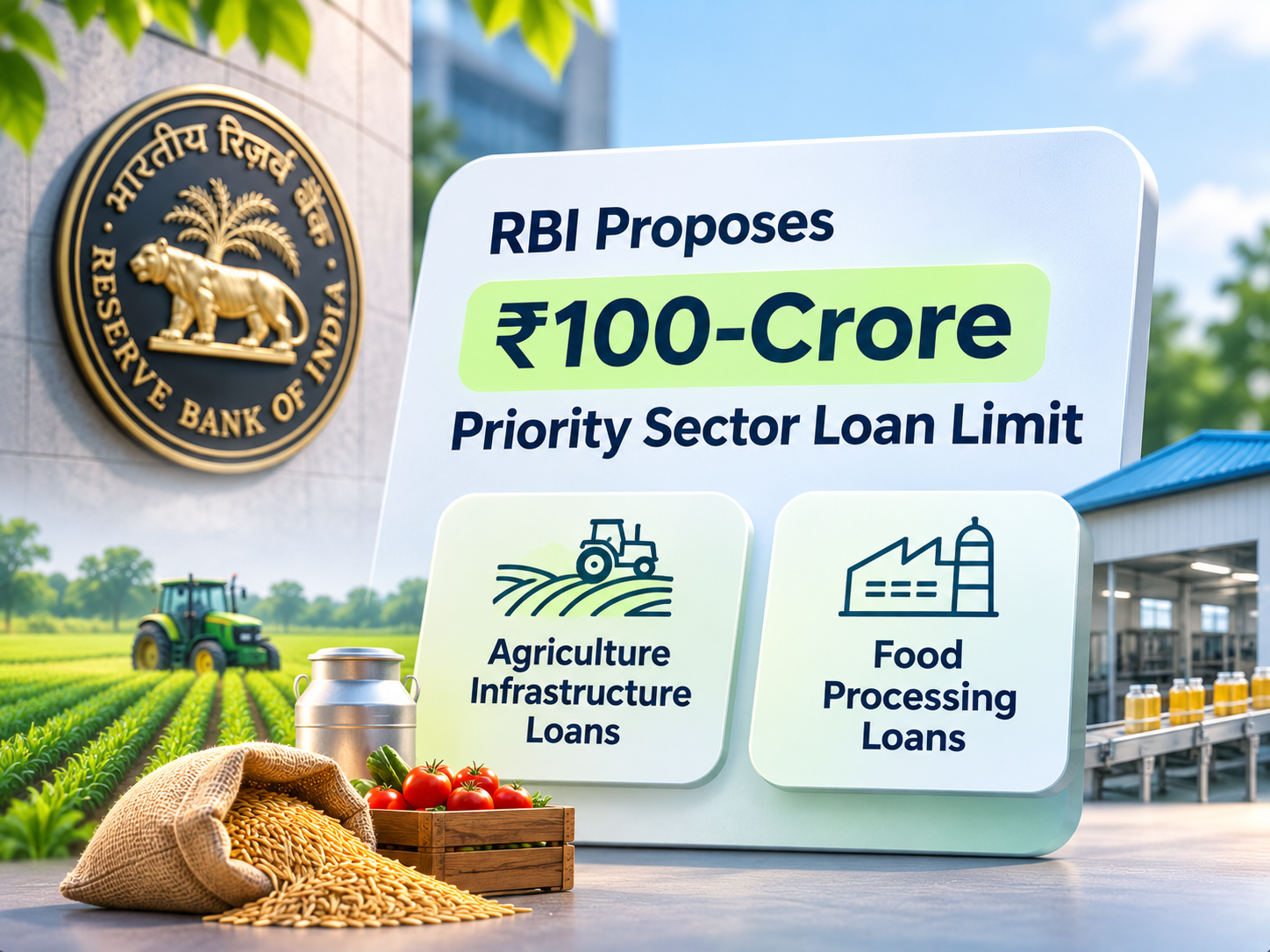
The Reserve Bank of India (RBI) has issued draft guidelines for commercial banks proposing that loans up to Rs 100 crore per borrower for agriculture infrastructure and for food and agro-processing be treated as priority sector lending (PSL).
In the draft RBI (Commercial Banks – Priority Sector Lending – Targets and Classification) Directions, 2026, the central bank has also suggested revisions to eligibility norms for small and marginal farmers, as well as for housing, education and renewable energy loans.
It has kept the overall PSL target unchanged at 40% of adjusted net bank credit (ANBC) or the credit equivalent of off-balance sheet exposures, whichever is higher. The agriculture sub-target continues at 18%, and the micro enterprises target remains 7.5%.
Higher limits for agriculture and food processing
As per the proposal, lending to corporate farmers, Farmer Producer Organisations (FPOs), partnership firms and cooperatives for specified agricultural activities would qualify under PSL up to a combined cap of Rs 4 crore per borrower.
For agriculture infrastructure, the RBI has proposed that an aggregate sanctioned amount of up to Rs 100 crore per borrower be eligible for PSL. Activities covered include building warehouses and cold storages, soil conservation and watershed development, and establishing compressed biogas plants.
Similarly, loans for food and agro-processing would be eligible for priority sector classification up to Rs 100 crore per borrower.
The draft also suggests that loans up to Rs 2.5 lakh to individuals engaged only in allied agricultural activities be counted under the small and marginal farmers category, without linking eligibility to landholding.
Changes to housing and education loan eligibility
The RBI has proposed that individual education loans up to Rs 25 lakh, including for vocational programmes, be treated as PSL.
For housing purchase or construction, the suggested caps are Rs 50 lakh in centres with population of 50 lakh and above, Rs 45 lakh in centres with population from 10 lakh to below 50 lakh, and Rs 35 lakh in centres with population below 10 lakh.
It also proposes limits for repair loans for damaged homes at Rs 15 lakh, Rs 12 lakh and Rs 10 lakh, respectively, across the same population buckets.
Higher limits for social infrastructure and renewable energy
Under the draft, loans up to Rs 8 crore per borrower for creating schools and drinking water and sanitation facilities would qualify, and loans up to Rs 12 crore per borrower for healthcare facilities in Tier 2 to Tier 6 centres would also be eligible.
For renewable energy, the proposed PSL-eligible limit is Rs 35 crore for borrowers setting up renewable energy-based power generation projects and public utilities, while for individual households the cap is Rs 10 lakh per borrower.
On-lending and priority sector certificates
The RBI has proposed capping, at 5% of a bank’s average PSL achievement over the previous financial year’s four quarters, the loans given to NBFCs, housing finance companies and the National Cooperative Development Corporation (NCDC) for on-lending. This cap would not apply to lending to NBFC-MFIs and other MFIs that belong to an RBI-recognised self-regulatory organisation.
The draft also lays out a structure for priority sector lending certificates (PSLCs), under which banks exceeding PSL requirements can sell certificates to banks that fall short. These certificates would be traded in standard lots of Rs 25 lakh and in multiples, with market-based fees.
It notes that PSLCs help banks meet targets by buying notional compliance from banks with surplus PSL performance, without transferring either credit risk or the underlying loan assets.
The RBI has further proposed quarterly monitoring of PSL compliance to support steady credit flow to priority sectors, with compliance tracked on a calendar-quarter basis.
Once the RBI issues the final directions, they will take effect immediately.
Source: MoneyControl
Related Posts

SEBI to roll out AI-use rules for capital markets with investor-protection guardrails
MFDs using AI-led tools for client communication or investment processes should prepare for SEBI’s upcoming guardrails on disclosures, accountability and human oversight.

SEBI forms panel to overhaul ICDR rules for IPOs, FPOs and QIPs
SEBI’s review of IPO/FPO/QIP rules could streamline disclosures and processes, potentially boosting primary market activity that impacts equity market sentiment and client interest.

Retail inflation jumps to 6.09% in October
CPI inflation crossing 6% raises the probability of an RBI rate hike, which can impact debt fund returns and client asset-allocation conversations.


SEBI to roll out AI-use rules for capital markets with investor-protection guardrails
MFDs using AI-led tools for client communication or investment processes should prepare for SEBI’s upcoming guardrails on disclosures, accountability and human oversight.
SEBI forms panel to overhaul ICDR rules for IPOs, FPOs and QIPs
SEBI’s review of IPO/FPO/QIP rules could streamline disclosures and processes, potentially boosting primary market activity that impacts equity market sentiment and client interest.
Retail inflation jumps to 6.09% in October
CPI inflation crossing 6% raises the probability of an RBI rate hike, which can impact debt fund returns and client asset-allocation conversations.