


RBI amends EDF rules for service exporters, freelancers under FEMA: ₹10 lakh threshold, relief for resident individuals
November 3, 2026
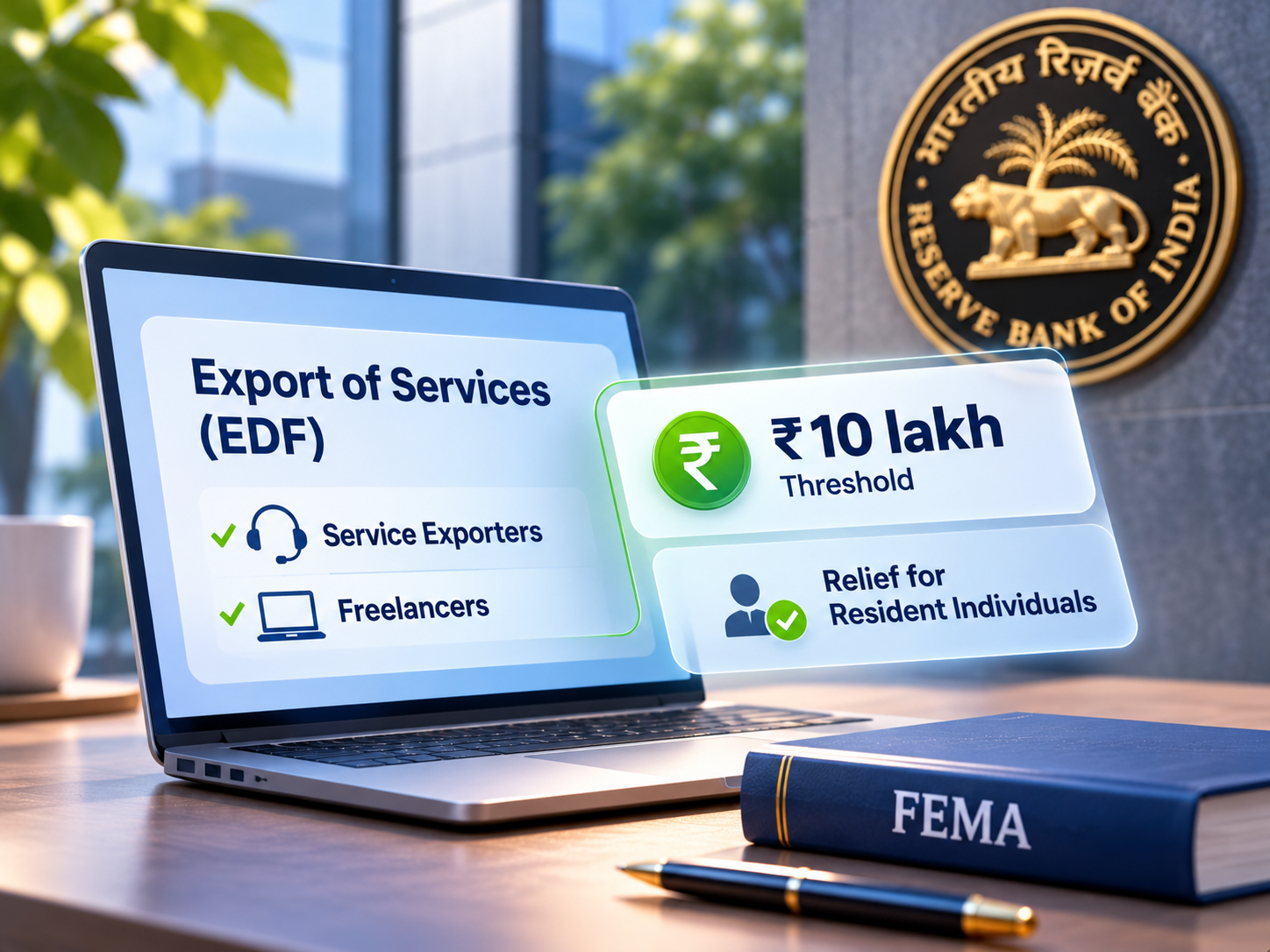
The Reserve Bank of India (RBI) has issued fresh clarity on when service exporters must file an Export Declaration Form (EDF). Under the new rules, resident individuals will be treated as having filed the EDF once they share the necessary payment-related details with their authorised dealer (AD) bank.
These changes are part of the Foreign Exchange Management (Export and Import of Goods and Services) (Second Amendment) Regulations, 2026, notified in the Gazette on 2 November 2026. The amendments apply retrospectively from 1 October 2026.
They build on an earlier set of regulations dated 22 September, which also took effect from 1 October. The key points are outlined below.
Earlier EDF submission rules
The 22 September regulation required that “an exporter of services shall furnish to the specified authority a declaration in EDF specifying the amount representing the full export value of services, within 30 days from the end of month in which invoice for services has been raised.”
A service exporter dealing with multiple clients in a month could file a single EDF covering all such invoices.
Exporters of services other than software were allowed to submit the EDF on or before the date they received payment.
EDF filing framework
Under FEMA, the EDF is the form through which an exporter declares to the AD bank the details of services exported and the corresponding foreign currency receivables from overseas customers.
The AD bank then records this declaration in the RBI’s Export Data Processing and Monitoring System (EDPMS). The entry stays open against the exporter’s PAN until the bank receives the inward remittance and matches it with the EDF record.
As a rule, the EDF must be filed within 30 days from the end of the month in which the invoice is raised. For example, for invoices issued in October, the last date for EDF submission would be 30 November.
Changes introduced in the latest amendment
The 2 November amendment adds a formal definition of “resident individual” and clarifies when an EDF will be treated as submitted.
A resident individual is now defined as “a person resident in India who is a natural person.”
EDF requirement for resident individuals
A new clause now states: “The exporter of services shall be deemed to have submitted the EDF when such exporter, being a resident individual, provides information required in relation to the receipt of payment for such services to the Authorised Dealer for crediting the account of the exporter.”
In effect, individuals who earn from overseas clients—such as freelancers, content creators like YouTubers, and independent professionals—will not need to file a separate EDF, provided they give their bank all the required details related to the foreign remittance.
₹10 lakh threshold for other service exporters
For service exporters who are not resident individuals, the amendment extends a similar deemed-submission benefit where the inward remittance for a particular service export does not exceed ₹10 lakh (or equivalent in foreign currency).
Thus, companies and other non-individual service exporters can also avail simplified EDF compliance for eligible service export receipts up to ₹10 lakh.
Changes in import reporting under IDPMS
The RBI has also revised Regulation 18(1)(d), which governs how imports of services are reported in the Import Data Processing and Monitoring System (IDPMS).
IDPMS is the RBI’s system through which AD banks capture and track import transactions and associated payments.
Under the amended rule, the AD bank “shall enter details of import of service in IDPMS, as furnished by the importer who is a person other than a resident individual and where the invoice or the contract value is more than ₹10 lakh (or its equivalent in foreign currency), within five working days of receipt of details.”
This means AD banks must record service-import details in IDPMS within five working days once they receive the information, but only where the importer is not a resident individual and the invoice or contract value exceeds ₹10 lakh.
Consequently, resident individuals and transactions of ₹10 lakh or below are exempt from this IDPMS reporting requirement.
Disclaimer: This content is meant solely for information. Readers should seek advice from a qualified professional before acting on it.
Source: mint
Related Posts

SEBI to roll out AI-use rules for capital markets with investor-protection guardrails
MFDs using AI-led tools for client communication or investment processes should prepare for SEBI’s upcoming guardrails on disclosures, accountability and human oversight.

SEBI forms panel to overhaul ICDR rules for IPOs, FPOs and QIPs
SEBI’s review of IPO/FPO/QIP rules could streamline disclosures and processes, potentially boosting primary market activity that impacts equity market sentiment and client interest.

Retail inflation jumps to 6.09% in October
CPI inflation crossing 6% raises the probability of an RBI rate hike, which can impact debt fund returns and client asset-allocation conversations.


SEBI to roll out AI-use rules for capital markets with investor-protection guardrails
MFDs using AI-led tools for client communication or investment processes should prepare for SEBI’s upcoming guardrails on disclosures, accountability and human oversight.
SEBI forms panel to overhaul ICDR rules for IPOs, FPOs and QIPs
SEBI’s review of IPO/FPO/QIP rules could streamline disclosures and processes, potentially boosting primary market activity that impacts equity market sentiment and client interest.
Retail inflation jumps to 6.09% in October
CPI inflation crossing 6% raises the probability of an RBI rate hike, which can impact debt fund returns and client asset-allocation conversations.