


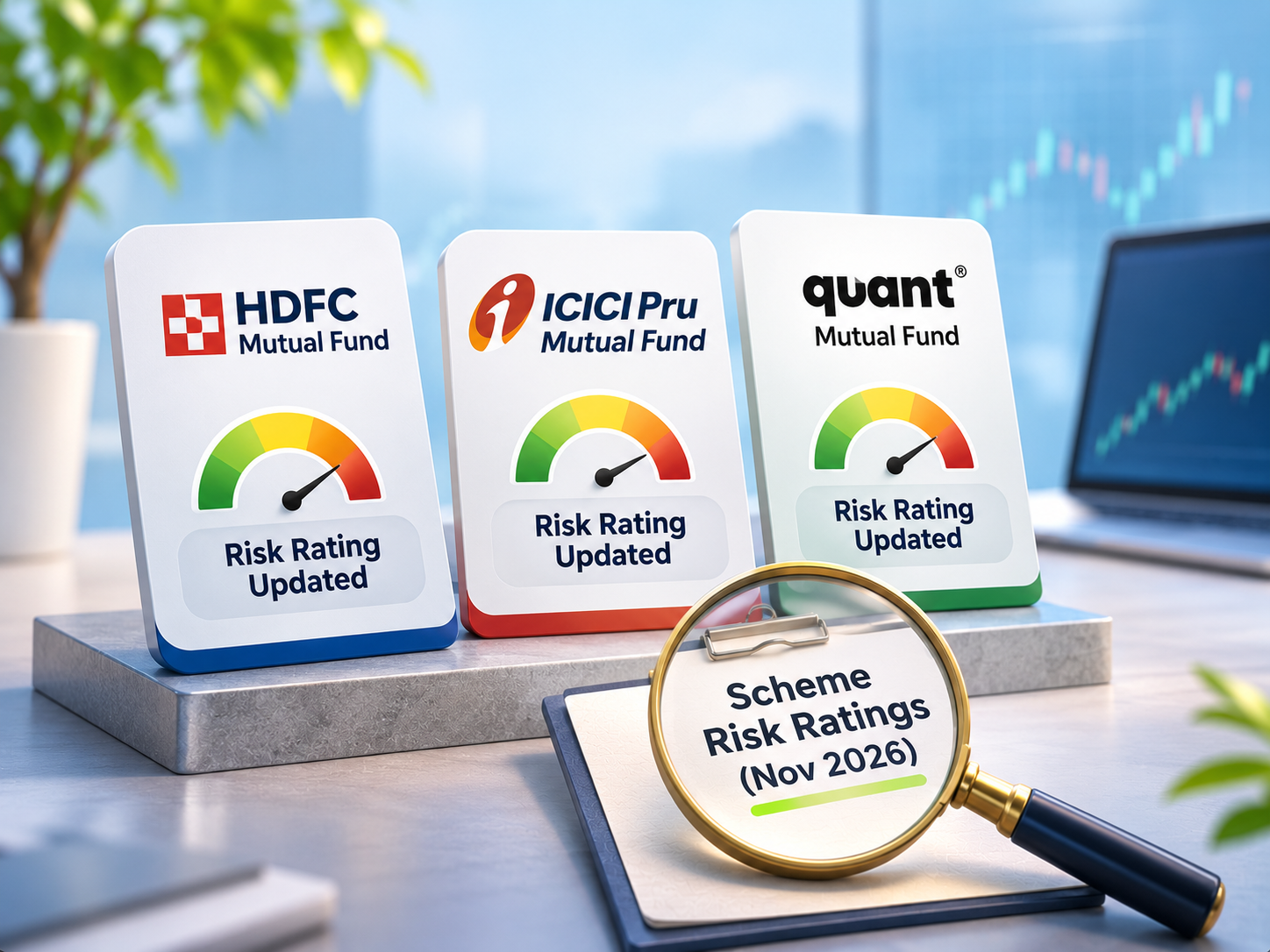
Investing in HDFC, ICICI Pru or Quant mutual funds? Check the latest changes in scheme risk ratings in November 2026
November 10, 2026
A lower risk label doesn’t ensure higher returns or protect capital, and a higher label doesn’t automatically make a scheme inappropriate.
In November 2026, several mutual fund houses updated the risk-o-meter levels of various schemes across equity, debt, hybrid, gold and fund-of-funds categories.
These updates are important because investors often use the risk-o-meter to gauge the risk profile of a scheme. However, an increase or decrease in the disclosed risk level does not automatically indicate that the scheme’s objective or core features have changed.
For investors, the main point is that most of these changes reflect a reassessment of risk based on the underlying portfolio, rather than any change to the scheme itself.
1. HDFC Mutual Fund: Risk labels revised for four schemes
On November 7, HDFC Mutual Fund announced risk-o-meter changes for four schemes, based on portfolio assessment as of October 31, 2026.
The revisions are:
HDFC Dynamic Term Fund: moved down from moderately high to moderate.
HDFC Multi-Asset Active Fund of Funds: moved up from high to very high.
HDFC Nifty Large Midcap 250 Plus 8-13 yr G-Sec 70:30 Index Fund: moved up from high to very high.
HDFC NIFTY SDL Plus G-Sec Jun 2027 40:60 Index Fund: moved up from low to moderate to low.
HDFC Mutual Fund stated that benchmark risk-o-meters are unchanged and that product labels, terms and conditions and other scheme details remain the same.
The fund house has uploaded the relevant addendum on its website.
ICICI Prudential Mutual Fund: Gold and life-cycle schemes shift to very high risk
ICICI Prudential Mutual Fund also disclosed risk-rating changes for four schemes on November 7.
ICICI Prudential Gold ETF Fund of Fund and ICICI Prudential Multi-Asset Active Fund of Fund were reclassified from high to very high.
Two life-cycle funds saw sharp upward revisions:
ICICI Prudential Life Cycle Fund 2036: from moderate to very high.
ICICI Prudential Life Cycle Fund 2041: from moderately high to very high.
These ratings were determined using portfolios as of October 31, 2026. The AMC said the Scheme Information Documents and Key Information Memorandums remain otherwise unchanged.
This is especially relevant for life-cycle funds, where asset allocation changes over time. Investors should look at the current portfolio and allocation instead of relying only on the target year in the scheme name to infer risk.
Quant Mutual Fund: Arbitrage FoF risk label reduced
Quant Mutual Fund lowered the risk-o-meter for Quant Income Plus Arbitrage Fund of Fund from moderate to low to moderate.
The change was communicated on November 6, and the AMC noted that product label details, features, and terms and conditions are unchanged.
Investors should not treat the lower risk label as an assurance of returns or capital safety, as the scheme remains exposed to market risks.
Aditya Birla Sun Life Mutual Fund: Gold fund moves down a notch; liquid fund moves up
On November 6, Aditya Birla Sun Life Mutual Fund revised risk-o-meters for four schemes based on monthly portfolios as of October 30.
The updates are:
Aditya Birla Sun Life Liquid Fund: from moderate to moderately high.
Aditya Birla Sun Life Ultra Short to Short Term Fund: from moderate to low to moderate.
Aditya Birla Sun Life Gold Fund: from very high to high.
Aditya Birla Sun Life Financial Services Sectoral Debt Fund: from moderate to low to moderate.
The liquid fund change stands out because such funds are often used for short-term parking of surplus cash; a higher risk classification makes it important to review the portfolio exposures.
The gold fund’s risk level has reduced by one category, but that does not imply gold has become risk-free or that volatility will necessarily be lower.
The AMC said other scheme features and terms and conditions remain the same.
Franklin Templeton Mutual Fund: Three schemes reclassified
Franklin Templeton Mutual Fund revised the risk-o-meters of three schemes on November 6.
Franklin India Conservative Hybrid Fund: from moderate to moderately high.
Franklin India Ultra Short to Short Term Fund: from moderate to low to moderate.
Franklin India Money Market Fund: from moderate to low to moderate.
The AMC said the revised ratings were computed under SEBI’s mutual fund framework using portfolios as of October 30, 2026, and that other terms and conditions are unchanged.
It also noted that Franklin India Ultra Short to Short Term Fund was previously named Franklin India Low Duration Fund, with the name change effective August 25, 2026.
What does a risk-o-meter change indicate for investors?
SEBI mandates that mutual funds disclose a scheme’s risk-o-meter. This label helps investors understand the risk level and evaluate whether it aligns with their risk appetite.
The six risk levels, from lowest to highest, are:
Low
Low to moderate
Moderate
Moderately high
High
Very high
The risk assessment is based on the portfolio and relevant risk drivers such as market risk, credit risk, interest-rate risk and liquidity, depending on the scheme category. AMCs also publish the benchmark’s risk level.
These requirements are covered under SEBI’s Master Circular dated March 20, 2026.
Should investors act on these changes by buying or redeeming?
Not necessarily. A risk-o-meter change by itself is not sufficient reason to invest or exit.
Investors should focus on three checks:
Review the latest portfolio: See whether the change is due to shifts in equity allocation, debt duration, credit profile, or other holdings.
Assess against the benchmark: Consider the scheme’s risk label along with the benchmark’s risk-o-meter.
Re-evaluate time horizon: Especially for short-term debt, gold, and long-term hybrid allocations, ensure the updated risk level fits the investor’s goals and ability to handle volatility.
A lower risk label does not promise better performance or capital protection, and a higher label does not automatically make a scheme unsuitable.
The key is to identify what is causing the risk label change, rather than relying on the risk-o-meter alone for decisions.
Source: mint
Related Posts

Arbitrage mutual funds swing back to inflows in October 2026 with ₹3,929 crore: Top 5 schemes by 1, 3, 5-year returns
Arbitrage funds saw a sharp flow reversal in Oct 2026 with ₹3,929 crore inflows, highlighting renewed short-term parking demand rather than higher equity risk appetite.

India ETFs draw ₹35,120 crore in Q3 as large-cap, precious metals lead inflows
Q3 ETF inflows stayed strong and concentrated in large-cap index and gold-linked products, signalling where client demand is shifting and where duration risk is being avoided.

Debt Mutual Funds See ₹1 Lakh Crore Outflows in June
Large June redemptions from debt funds are mainly quarter-end, tax-driven flows rather than a lasting shift away from fixed income, so MFDs should focus on explaining this seasonality to clients.


Arbitrage mutual funds swing back to inflows in October 2026 with ₹3,929 crore: Top 5 schemes by 1, 3, 5-year returns
Arbitrage funds saw a sharp flow reversal in Oct 2026 with ₹3,929 crore inflows, highlighting renewed short-term parking demand rather than higher equity risk appetite.
India ETFs draw ₹35,120 crore in Q3 as large-cap, precious metals lead inflows
Q3 ETF inflows stayed strong and concentrated in large-cap index and gold-linked products, signalling where client demand is shifting and where duration risk is being avoided.

Gold ETF inflows beat full-year 2025 total in just 10 months, cross Rs 49,000 crore
Gold ETF inflows have already exceeded last year’s full total, signalling strong client appetite for gold as a long-term diversifier despite a slower October.