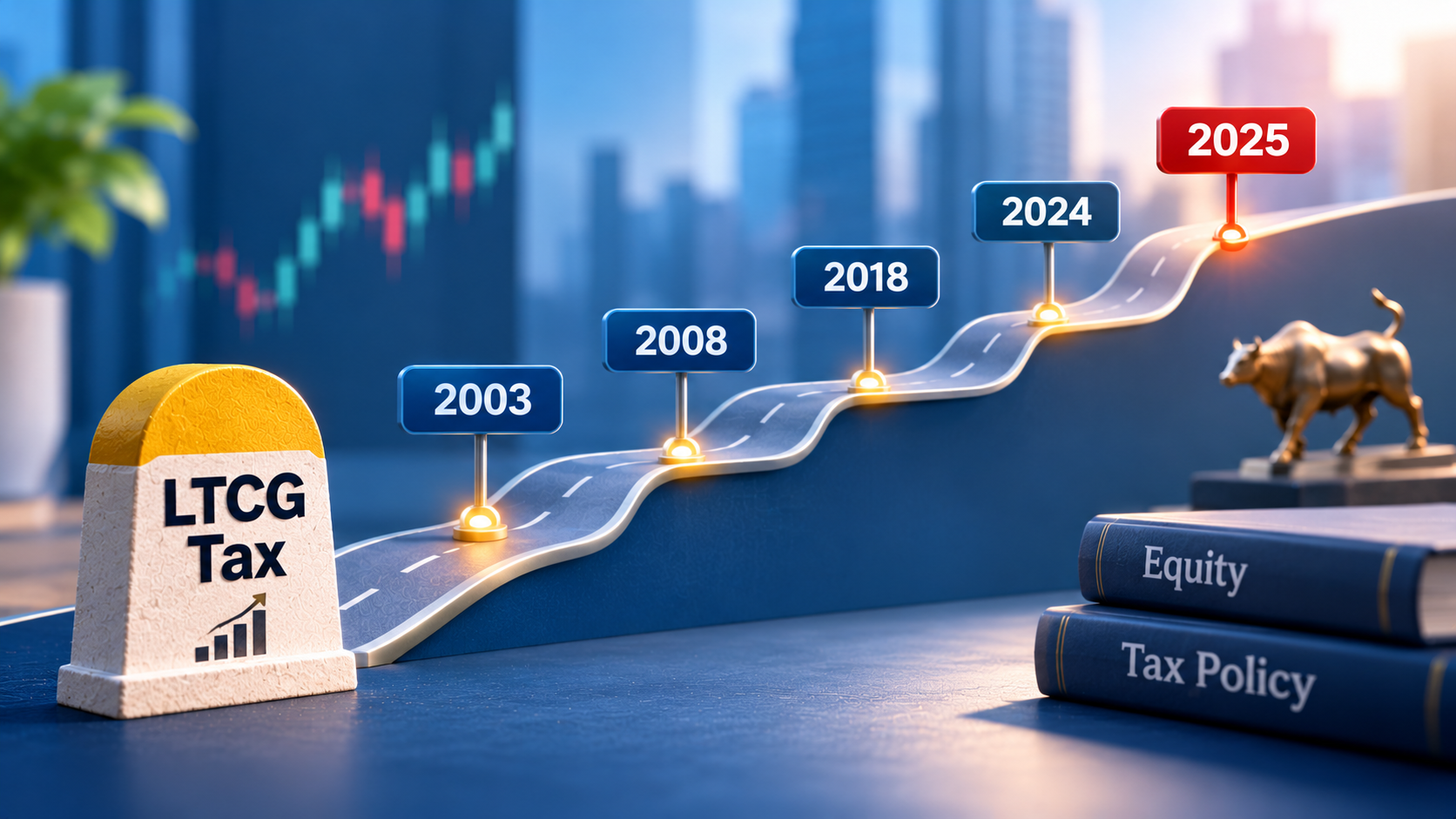
Equity LTCG tax evolution in India: A timeline of policy shifts since 2003
November 3, 2026
According to a Reuters report, the Securities and Exchange Board of India (SEBI) has advised the government to remove long-term capital gains (LTCG) tax on equity investments made by foreign portfolio investors (FPIs). The regulator has also suggested tax concessions for domestic mutual fund investors when they redeem units and reinvest the proceeds into other schemes.
These suggestions come at a time of persistent foreign outflows and rising worries that equity taxation is weighing on investor sentiment. The government has not yet agreed to these recommendations. Below is a timeline of how LTCG tax on equities has changed, from its removal in 2004 to its reintroduction in 2018 and the rate hike in 2024.
Before 2003: LTCG tax existed
Prior to the 2003 exemption, long-term capital gains from listed shares were taxable under the Income-tax Act, with the applicable rate and treatment depending on the type of security and the category of investor. Foreign institutional investors (FIIs)—the earlier classification for overseas portfolio investors, later merged into the FPI category in 2014—were also liable to capital gains tax as per the rules applicable to them.
February 28, 2003: Short-term LTCG relief announced
In the Union Budget for 2003-04, Finance Minister Jaswant Singh introduced a temporary exemption for listed shares bought on or after March 1, 2003, and sold after being held for at least one year. The objective was to stimulate the capital markets and promote equity investing.
July 8, 2004: Complete abolition of LTCG on securities
With the change in government, Finance Minister P. Chidambaram announced a broader overhaul in the Union Budget 2004-05. He proposed eliminating LTCG tax on securities altogether and replacing it with a Securities Transaction Tax (STT) on trades executed on stock exchanges.
The suggested STT rate was 0.15 per cent of the transaction value, payable by the buyer. At the same time, the government proposed cutting the tax on short-term capital gains from securities to a flat 10 per cent.
This new system took effect from October 1, 2004. Section 10(38) of the Income-tax Act granted an exemption for eligible long-term gains from listed equity shares, provided the sale transaction attracted STT.
2017: Stricter conditions for claiming exemption
Over time, the tax-free regime came under the scanner as concerns grew that some investors were misusing it to convert unaccounted income into tax-free capital gains.
To curb such practices, the Finance Act, 2017 amended Section 10(38). Under the revised framework, investors purchasing equity shares on or after October 2004 would generally be eligible for the LTCG exemption only if STT was paid at both the purchase and sale stages.
In June 2017, the Central Board of Direct Taxes (CBDT) issued a notification specifying categories of transactions that would be spared from this additional STT-at-purchase requirement, subject to safeguards.
February 1, 2018: LTCG tax brought back
In the Union Budget 2018-19, Finance Minister Arun Jaitley reintroduced LTCG tax on listed equities, ending the 14-year period of exemption.
The proposal imposed a 10 per cent tax on annual long-term capital gains above ₹1 lakh. Unlike some other capital gains provisions, indexation benefits—where the purchase cost is adjusted for inflation—were not allowed.
A new Section 112A was inserted to tax long-term gains from listed equity shares, equity-oriented mutual funds and units of business trusts.
The new regime applied from April 1, 2018, for FY 2018-19. Long-term gains above ₹1 lakh from listed equity shares, equity-oriented mutual funds and business trust units became taxable at 10 per cent under Section 112A.
The exemption remained linked to STT conditions. In contrast to the earlier tax-free phase, investors now had to bear both STT on eligible trades and income tax on long-term gains exceeding the annual threshold.
July 23, 2024: LTCG rate hiked to 12.5 per cent
In the Union Budget 2024-25, Finance Minister Nirmala Sitharaman increased the LTCG tax rate on qualifying listed equities from 10 per cent to 12.5 per cent. Simultaneously, the annual exemption limit was raised from ₹1 lakh to ₹1.25 lakh. These changes took effect immediately for transfers executed on or after July 23, 2024.
The Budget also increased the short-term capital gains tax rate on STT-paid equity shares, equity-oriented mutual funds and business trust units from 15 per cent to 20 per cent.
2026: Fresh push for LTCG relief
Concerns about the overall tax load on equity investments and the competitiveness of Indian markets have revived the policy debate.
On July 20, 2026, the government informed the Lok Sabha that it was not considering any proposal to abolish LTCG tax on equities. Minister of State for Finance Pankaj Chaudhary further clarified that the 12.5 per cent LTCG rate applies uniformly to domestic retail investors and FPIs.
On November 2, Reuters reported that SEBI has now recommended scrapping LTCG tax for foreign investors and suggested that domestic mutual fund investors should not be subject to LTCG tax when switching between schemes after holding their units for more than one year.
Source: bsindia
Related Posts

SEBI to roll out AI-use rules for capital markets with investor-protection guardrails
MFDs using AI-led tools for client communication or investment processes should prepare for SEBI’s upcoming guardrails on disclosures, accountability and human oversight.

SEBI forms panel to overhaul ICDR rules for IPOs, FPOs and QIPs
SEBI’s review of IPO/FPO/QIP rules could streamline disclosures and processes, potentially boosting primary market activity that impacts equity market sentiment and client interest.

Retail inflation jumps to 6.09% in October
CPI inflation crossing 6% raises the probability of an RBI rate hike, which can impact debt fund returns and client asset-allocation conversations.


SEBI to roll out AI-use rules for capital markets with investor-protection guardrails
MFDs using AI-led tools for client communication or investment processes should prepare for SEBI’s upcoming guardrails on disclosures, accountability and human oversight.
SEBI forms panel to overhaul ICDR rules for IPOs, FPOs and QIPs
SEBI’s review of IPO/FPO/QIP rules could streamline disclosures and processes, potentially boosting primary market activity that impacts equity market sentiment and client interest.
Retail inflation jumps to 6.09% in October
CPI inflation crossing 6% raises the probability of an RBI rate hike, which can impact debt fund returns and client asset-allocation conversations.